Pain Clinic Rush
Pain Clinic Workflow, Team Coordination & Mobile Games
The Challenge
A pain clinic coordinates several patients through a sequence of connected spaces and tasks. Patients arrive and check in, staff prepare them for procedures, treatment rooms must become available, recovery beds must be managed, and patients must be safely discharged. Each stage depends on the others.
When patient arrivals increase, a delay or missed handoff in one area can affect the whole clinic. The work is not only about speed. Staff must communicate, prepare the right space and supplies, maintain safety, and recognize when a patient needs attention before moving to the next stage.
The Big Idea
Can the flow of a busy pain clinic become a fast-paced management game built around coordination, safe handoffs, and teamwork?
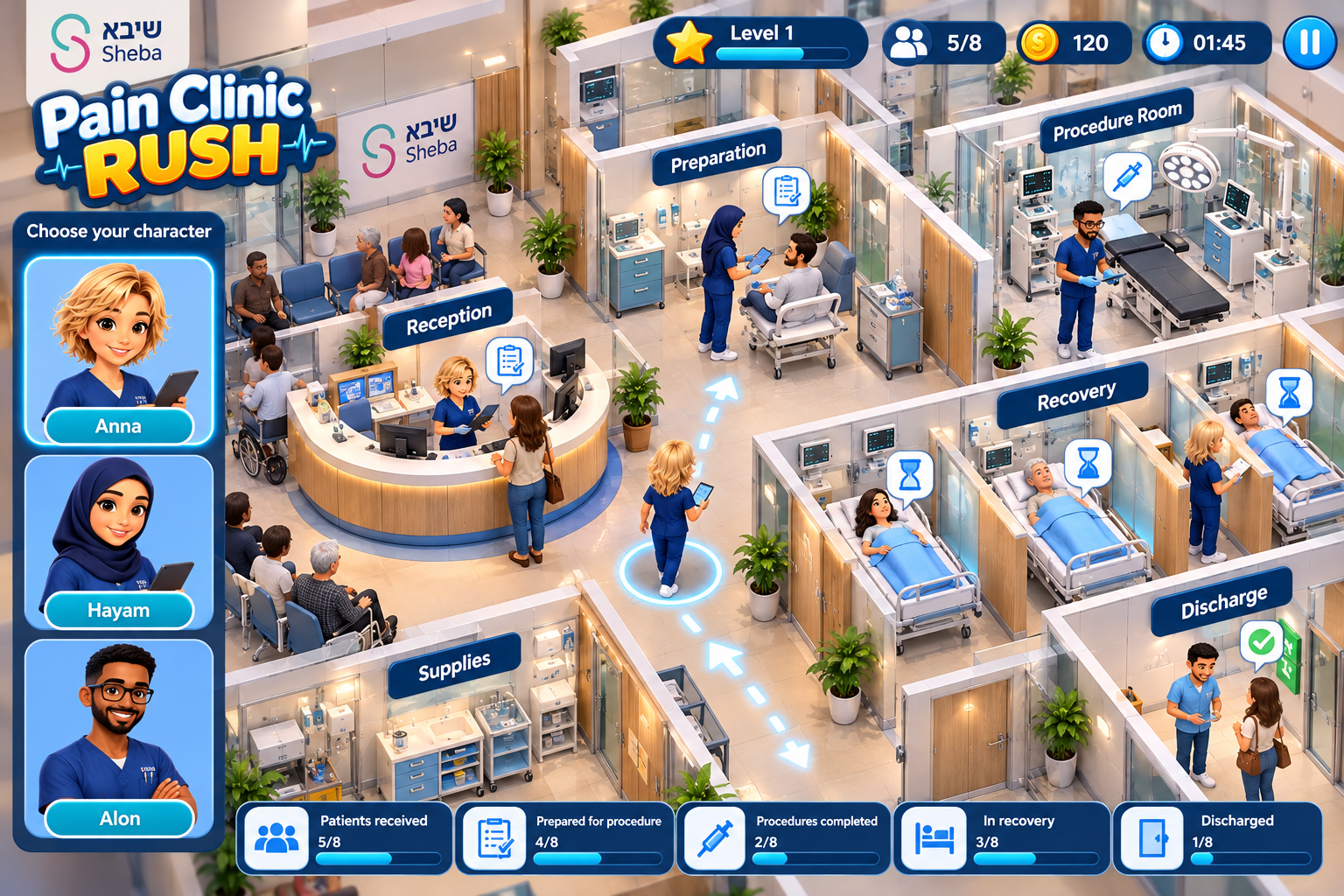
Pain Clinic Rush is intended for a mainstream audience, not only healthcare professionals. Inspired by approachable mobile management games such as My Perfect Hotel, it would let a player choose a character and help the clinic receive patients, prepare them, move them to procedure rooms, manage recovery beds, and complete discharge. The goal is a fun mobile game that develops prioritization, team management, and quick decision-making through play without feeling like traditional training.
The Clinic Loop
- Reception: welcome patients and begin the clinic visit.
- Preparation: complete the required preparation before a procedure.
- Procedure: match a prepared patient with an available treatment room and team.
- Recovery: manage limited beds while patients complete the appropriate recovery period.
- Discharge: complete the final handoff and release the patient from the clinic.
As demand grows, the player could earn points, open additional rooms, add staff, improve equipment, and make choices about which bottleneck to address first.
Possible Directions
- Short levels based on the real sequence and layout of Sheba's Pain Clinic.
- Several playable staff characters with different responsibilities or movement patterns.
- Patient queues and room capacity that require prioritization rather than constant tapping.
- Teamwork bonuses for good preparation and clean handoffs between clinic stages.
- Safety consequences that slow the clinic when the player skips an essential step.
- Upgrades that improve flow without suggesting that fewer staff or faster care is always better.
Design Questions
- How much real pain-clinic context does a mainstream player need before the workflow becomes understandable?
- Which real clinic steps are essential to represent, and which can be simplified?
- What should create challenge: limited rooms, patient arrivals, preparation tasks, staffing, recovery time, or communication?
- How can the game reward teamwork and safety rather than speed alone?
- What parts of the actual Sheba layout and illustrated characters may be used publicly?
What This Is Not
- Not a clinical decision-making or procedure-training simulator.
- Not a claim that real patients should be moved through care as quickly as possible.
- Not a substitute for validated safety or staff training.
- Not a place to use identifiable patient information.
Why This Matters
A strong prototype could make the hidden coordination behind a pain-clinic visit visible and playable. It could show how preparation, room availability, recovery, discharge, and teamwork form one connected system without burdening players with complicated medical questions.